Field and stream
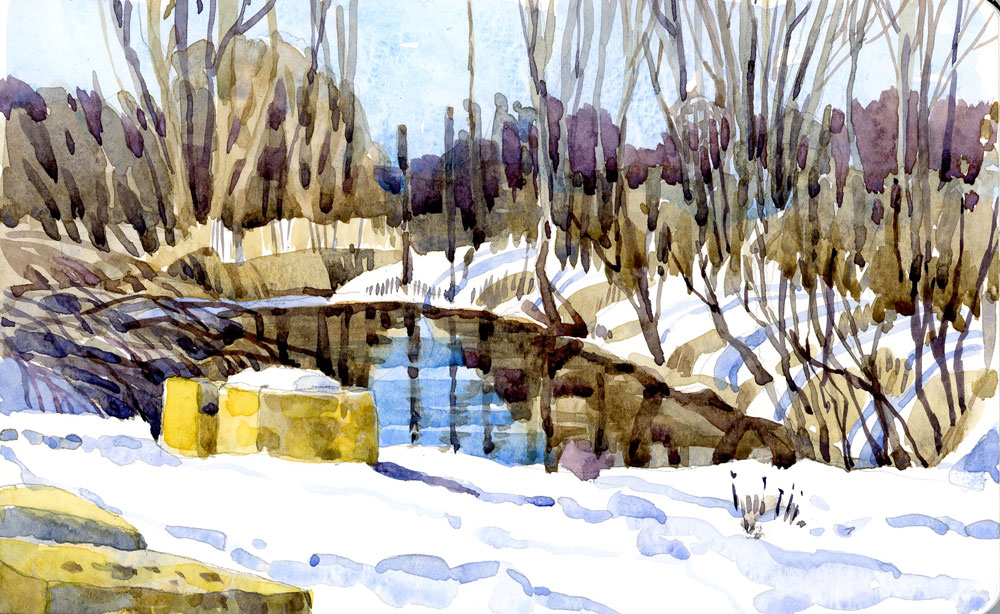
Posted: February 19, 2012 Filed under: Uncategorized 6 CommentsI stopped my car at this spot in l’Anse à l’Orme woods today, not only because there was a view of water (an actual flowing stream instead of a frozen lake!) but also because of the yellow concrete blocks that obstructed my view of the reflections. I have no idea why they are there but it allowed me to add a complementary colour to my usual blue/purple colour scheme.
Someone asked me the other day if I intentionally add a dominant element in the composition. I guess the answer is that I do create a “centre of interest” in my sketches, but maybe not always intentionally. That comes from my watercolour training with Ed Whitney. When I first studied with him in Maine he was over 90 years old, and he taught me, and countless other watercolour painters, to plan our compositions carefully and then paint them quickly to retain freshness. And part of that planning was establishing a dominant colour and value, and a centre of interest in the painting. A place where the darkest and lightest areas meet and where the brightest colours reside. I still carry my painting supplies in my green canvas Whitney bag and perhaps every time I do a sketch in my Moleskine these days one of Mr. Whitney’s principles comes to mind.
This is my music
Posted: February 18, 2012 Filed under: Uncategorized 7 CommentsThe best thing about painting in my car on Saturday morning is listening to “This is my music” on the CBC. Every week there’s a different invited musician who makes a playlist and talks about the music that shaped their life and musical career. Today the host was cellist Susie Napper and when I tuned in Artur Rubinstein was playing Chopin. Here’s a link: http://www.youtube.com/watch?v=dNcb3inSg2I
Snow bike
Posted: February 17, 2012 Filed under: Uncategorized 5 CommentsThis is my second sketch of the day. I did one during my lunch hour that I worked on for some time and realized that it was really boring. Then leaving school today I saw this bike and wondered if it had been there all winter or if someone decided that spring was here. I sketched this one pretty fast but sometimes the fast ones work out better than the ones that take a long time.

Waiting for spring
Posted: February 16, 2012 Filed under: Uncategorized 10 CommentsI’m running out of cobalt blue. That’s the colour that I use for all the snow shadows (sometimes I mix it with a cool red like alizarin crimson too). In the fall I wondered if I would be able to continue painting all winter long in my car. Now I know the winter isn’t over yet (there’s still March with all the “in like a lion and out like a lamb” stuff) but somehow I did manage to do quite a good lot of snow paintings. More than I ever thought possible back in the fall. And except for the day when my paint froze right on the brush, it has been a surprisingly great experience. I think I may actually miss the snow when it’s gone.

The quick pose
Posted: February 15, 2012 Filed under: Uncategorized Leave a commentQuick poses can be so challenging because you know that the timer is going to go off at any moment and the model will change positions. You need to capture the shape of the body quickly and get the lines right at the same time because there’s no time to erase and correct.

The same but different
Posted: February 14, 2012 Filed under: Uncategorized 5 CommentsThese silos have been in my sketches before. But today there was something different about the painting experience. It was warm enough outside to open the car window. I heard birds. And there was a smell of cow manure from the cattle barn nearby.
A woman and her mother walked by the car, stopped to talk and had a look at what I was doing. And we all agreed that we may be emerging from the dark days of winter.

In the blink of an eye
Posted: February 13, 2012 Filed under: Uncategorized 2 CommentsIf you’ve never attended a life-drawing studio you may be curious about how the three hours goes by. The model starts by doing 30-second poses so that people can warm up their drawing skills, then one-minute poses and from there three minutes, five minutes, 10 minutes and eventually a couple of long ones near the end of the session that are 15 or 20 minutes long. In the UQAM studio there’s always some great music playing — last time it was Fela Kuti and yesterday it was new-age psychedelic. Everyone in the room is completely focused on their own work, in trying to capture the essence of the pose or the particularity of a gesture. When you are that focused three hours goes by in the blink of an eye.
I wish I could spend every day drawing from the model.

Jean-Pierre
Posted: February 12, 2012 Filed under: Uncategorized 2 CommentsJean-Pierre the model. Muscled body of an older dancer. Face a lot like Max von Sydow. It was so hard to draw that massive head — deep, deep set eyes, broken nose like a hawk and a mouth like a slash. I’ll admit I was relieved when I had a view of his back for this pose.

And now with shovel
Posted: February 11, 2012 Filed under: Uncategorized 2 CommentsSometimes the best things are right under your nose, or even in your own backyard. This corner of my garden, with the rusty wheelbarrow and the old sheet of presswood leaning against the shed, has provided lots of interest for me this winter. And it becomes new for me every time it snows.

Narrow view
Posted: February 10, 2012 Filed under: Uncategorized 3 CommentsI was standing at a very narrow window to draw this scene, using both the upper and lower part of my little Moleskine. And the result is a kind of weird perspective — probably because I had to look both up and down to draw it. There’s the tree below my window, the cemetery for les Soeurs de Saint Croix in the middle and in the distance the infirmary for the Soeurs with an ambulance waiting in the garage. I’ve been wanting to draw this cemetery for some time because the crosses are perfectly aligned and there is such a sense of serenity, especially in winter.